
Building with RWAs
Robinhood Chain, Spark, and 430+ new tokenized assets onchain.

this week: rwa summer continues ∞ robinhood stocks onchain ∞ auctions in one click ∞ spark’s fx layer, powered by v4 ∞ something mega is here ∞ why slow trading matters
Community news
Build with RWAs on Robinhood Chain: Robinhood Chain is live, and Uniswap is the primary public AMM from day one. This week Uniswap Protocol and UniswapX went live alongside our apps, Wallet, and API. For builders, just one integration puts Robinhood Stock Tokens in the same workflow as any crypto-native token. Get started here.
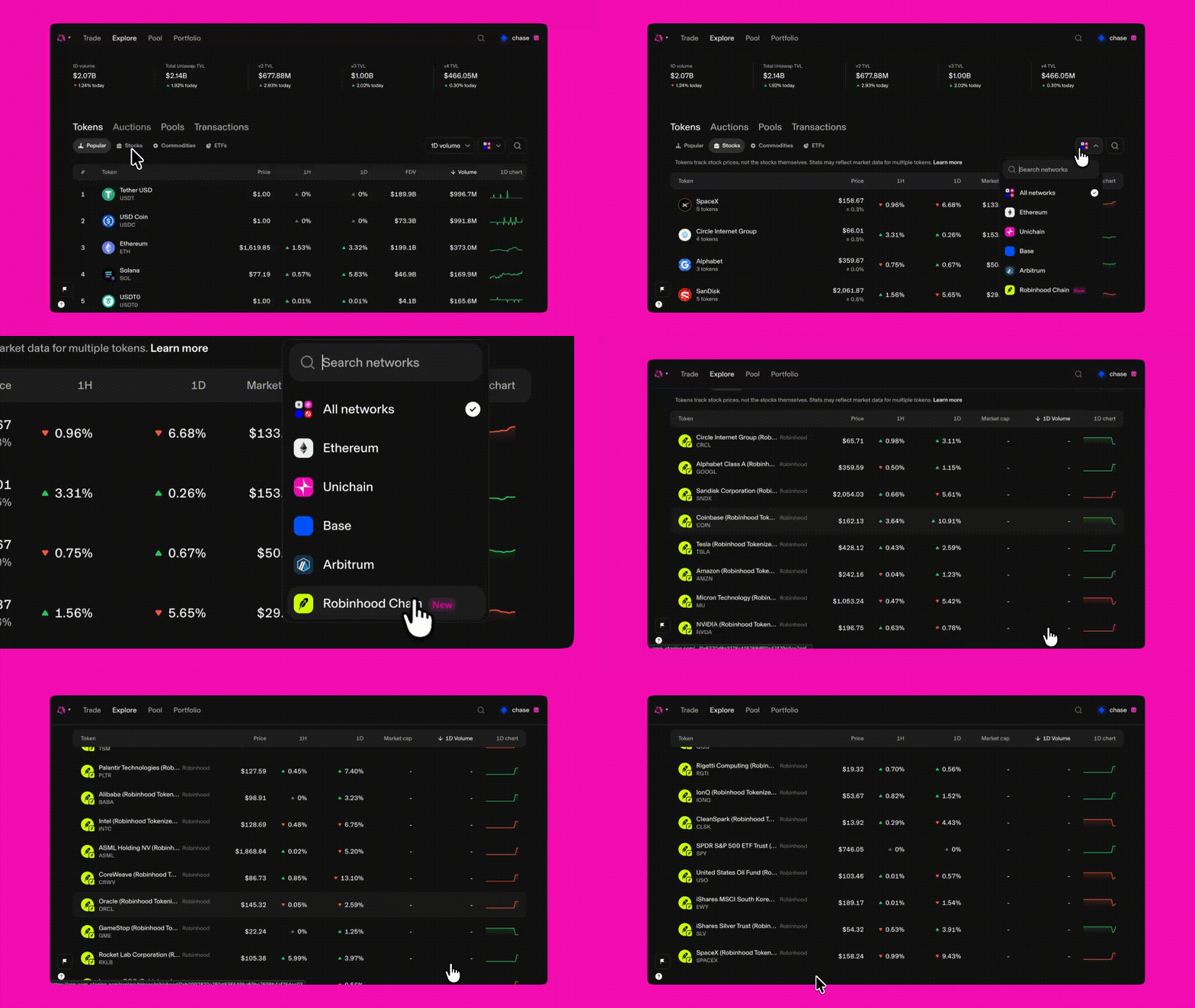
Speaking of real-world assets: Which I always am, only one of us is focused on fake world assets, Ondo’s tokenized stocks are now live on Uniswap apps: 430+ tokenized stocks and ETFs covering the most-traded US equities, across Ethereum and BNB Chain.
Bootstrap liquidity in a few clicks: Teams can now launch token auctions straight from the Uniswap Web App. Onchain price discovery, transparent distribution, and instant liquidity, no code required. It’s powered by Continuous Clearing Auctions (CCAs), and it’s live now on Ethereum, Arbitrum, Base, and Unichain, with more chains coming. Everything you need to bootstrap liquidity, in one place.
Shared stablecoin liquidity on v4: Spark just deployed ~$150M to Uniswap v4 to launch its Stablecoin FX Layer: shared infrastructure that lets stablecoins tap common depth instead of spinning up isolated pools. Across the first USDS/PYUSD and USDS/USDT pools, that liquidity did over $70M in volume in its first three days.
Next it moves to DualPool, a custom hook (coming soon) built to keep capital available the moment execution needs it, instead of sitting idle between swaps. Another builder composing a new market structure on top of the protocol with hooks, you love to see it.
Something mega is happening: MegaETH is now live on the Uniswap Web App, Wallet, and API. Swap on one of the fastest chains around, with 100,000 TPS and 10ms block times. And with Uniswap API support, agents can pair MegaETH’s MOSS CLI with Uniswap Skills to run swaps autonomously using a delegated key.
Who actually wins MetaMask swaps: For a wallet, swap execution is the product. Every swap in MetaMask runs a live comparison across about a dozen routers, and the best quote wins. Over the past few months, researcher Vaish Puri dug into MetaMask routing to find out who’s actually winning routes. Across 554K+ mainnet swaps, the Uniswap API took 52.4%: more than every other router combined, spread across 135K wallets. For everyday swappers, AMM routing came out ahead: pair after pair, day after day. Full study here.
Builder stories: Turbine
Turbine is a trustless batching exchange from Propeller Heads, the team behind Tycho. Orders track the market, stay private and MEV-protected, and settle in batches through a native solver running in a TEE. It uses Uniswap two ways: Turbine’s own liquidity lives in a Uniswap v4 hook (Turbine LP), and it routes through the rest of Uniswap’s liquidity (v2, v3, v4, and other hooks) via Tycho. We caught up with Propeller Heads founder and CEO Markus Schmitt to dig into how it works, and what it unlocks for onchain trading.
One thing that you’ve said when talking about Turbine is that exchanges are built for arbitrageurs first, and traders second. What made you want to flip this?
Traditional exchanges earn by selling speed, data, access, and other advantages to professional market makers. In that model, takers become the product and makers become the clients. That’s rational for exchanges because makers can price those advantages and will pay for them. In DeFi, takers finally look closely enough and act rationally enough that it pays to build for them. Once you build for takers, a new design space opens up. You can make trading cheaper by removing expensive intermediaries from the exchange.
DeFi has spent years optimizing for speed, but Turbine is kind of built on the opposite bet: a speedbump buys traders a better price, good things come to those who wait :). What did you see running solver infrastructure that convinced you the speed obsession was actually working against traders?
The focus on speed was driven by the TradFi HFT narrative, which traditional exchanges have an incentive to maintain, and by meme coin traders, for whom every second counts. Outside those use cases, most traders already trade slowly. The market already behaved this way; the narrative just lagged behind.
There’s a thesis layered under Turbine that’s bigger than better execution: that markets should be built for traders first. If what you’re building works, what’s the change in DeFi that you want to see?
Today, DeFi volume is still dominated by professional trading firms doing arbitrage. This is backwards. Markets should be dominated by takers. DeFi is the right place for that shift to start, especially on Ethereum, whose whole point is to reduce rent capture and intermediation. Blockchains provide the verifiable, trustless coordination taker-driven markets need.
Not everyone wants to trade the same assets at the same time, so the market has to coordinate trades across time and assets. That is what blockchains are good at. If we do this right, traders across many asset classes will come to Ethereum because they pay lower fees and the market is built in their favor. DeFi can play to its strengths here, and that can become an important difference from CEXs and traditional exchanges.